Mass consumption and retail
Grade 1 for premium shelf, private label and modern channels that require whole, uniform grain; Grade 2 for economy presentations, white labels and wholesale channels focused on price.
Oryza sativa
Non-GMO white rice (Oryza sativa) offered in two processing grades: Grade 1 for premium markets and Grade 2 for mass-consumption and industrial use. Varieties and grades tailored to different markets.
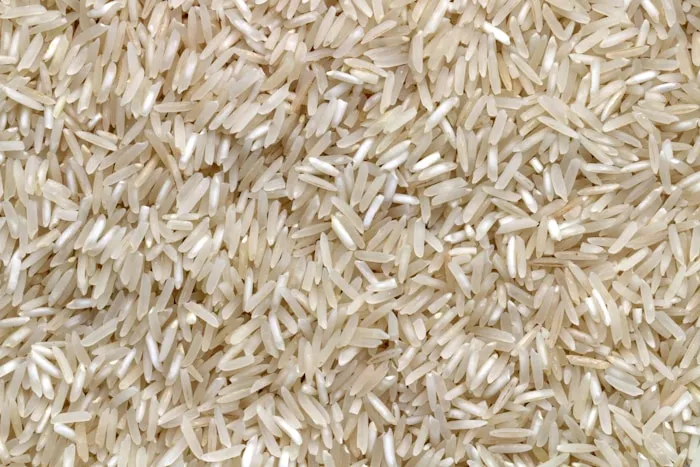
We trade non-GMO white rice (Oryza sativa) in two processing grades under a single logistics operation. Grade 1 is the superior quality, with maximum tolerances of 5% broken grains, 1.5% plastered grains and 1.7% pitted or spotted grains; it targets premium markets, retail and buyers that require whole, uniform and well-presented grain.
Grade 2 admits a higher share of broken grains (up to 15%), green or plastered grains (up to 3%) and foreign matter (up to 1%); it supplies mass consumption, the food industry and processes where whole grain integrity is not critical. Both grades share origin, botanical variety, new polypropylene bag packaging and a 1-year shelf life from manufacture.
1. Selection and dehulling. Paddy rice received at the plant is cleaned to remove stones, foreign bodies and impurities, then dehulled to produce brown rice. Husks are separated in-line for energy recovery.
2. Polishing and grade sorting. Brown rice is polished to remove bran until whiteness reaches ≥ 40%. After polishing, the flow is optically and size-sorted: whole, defect-free grains with low broken content form Grade 1; the remainder, with higher tolerances for broken, plastered grains and foreign matter, forms Grade 2.
3. Packaging and dispatch. Each grade is packed in new polypropylene bags with lot identification and manufacturing date. Lots are stored under controlled conditions until dispatch, with a 1-year shelf life from the production date.
Grade 1 for premium shelf, private label and modern channels that require whole, uniform grain; Grade 2 for economy presentations, white labels and wholesale channels focused on price.
Grade 2 as input for parboiled rice, flours, extruded snacks, beers and formulations where the grain is processed or milled and whole-grain integrity is not critical.
Grade 1 for hospitality, restaurants and institutional catering that require uniform cooking, impeccable presentation and consistent yield per bag.
Both grades available for export programs to Latin American, African and Middle Eastern markets, with documentation compliant with Codex Alimentarius and EC regulations on microbiology, mycotoxins and heavy metals.
Typical values from each grade's current technical data sheet. Shipment-specific analytical values are provided with dispatch documentation.
| Parameter | Value | Method |
|---|---|---|
| [G1] Broken grains | Máx. 5% | ISO 7301:2011 |
| [G1] Moisture | Máx. 13% | ISO 712:2009 |
| [G1] Plastered grains | Máx. 1,5% | ISO 7301:2011 |
| [G1] Pitted and spotted grains | Máx. 1,7% | ISO 7301:2011 |
| [G1] Red kernels | Máx. 1% | ISO 7301:2011 |
| [G1] Burnt grains | Máx. 0,5% | ISO 7301:2011 |
| [G1] Foreign matter | Máx. 0,5% | ISO 7301:2011 |
| [G1] Whiteness | ≥ 40% | ISO 11051:1994 |
| [G2] Broken grains | Máx. 15% | ISO 7301:2011 |
| [G2] Moisture | Máx. 13% | ISO 712:2009 |
| [G2] Green / chalky kernels | Máx. 3% | ISO 7301:2011 |
| [G2] Pitted and spotted grains | Máx. 2,5% | ISO 7301:2011 |
| [G2] Red kernels | Máx. 1% | ISO 7301:2011 |
| [G2] Burnt grains | Máx. 0,5% | ISO 7301:2011 |
| [G2] Foreign matter | Máx. 1% | ISO 7301:2011 |
| [G2] Whiteness | 40 – 42% | ISO 11051:1994 |
Tell us what you need (technical sheet, physical sample, formal quote) and our sales team gets back to you within 24 business hours.
Competitive energy alternative with excellent cost-benefit ratio for different production species.
Grain selected for flour milling, industrial baking and animal feed. Available in multiple varieties and protein grades.
We act as a solutions integrator bridging primary production and the technical needs of global markets. Tell us the product, volume and destination — we'll come back with a tailored proposal.