Biodiesel and HVO
Raw material for conventional biodiesel (FAME) and renewable diesel (HVO/HEFA). High unsaturated fatty acid content and low phosphorus make it ideal for catalytic hydrogenation processes.
Industrial-grade corn oil
Reddish-yellow viscous liquid obtained as a by-product of the dry milling process of corn for bioethanol production. Critical input for advanced biofuels and oleochemistry.
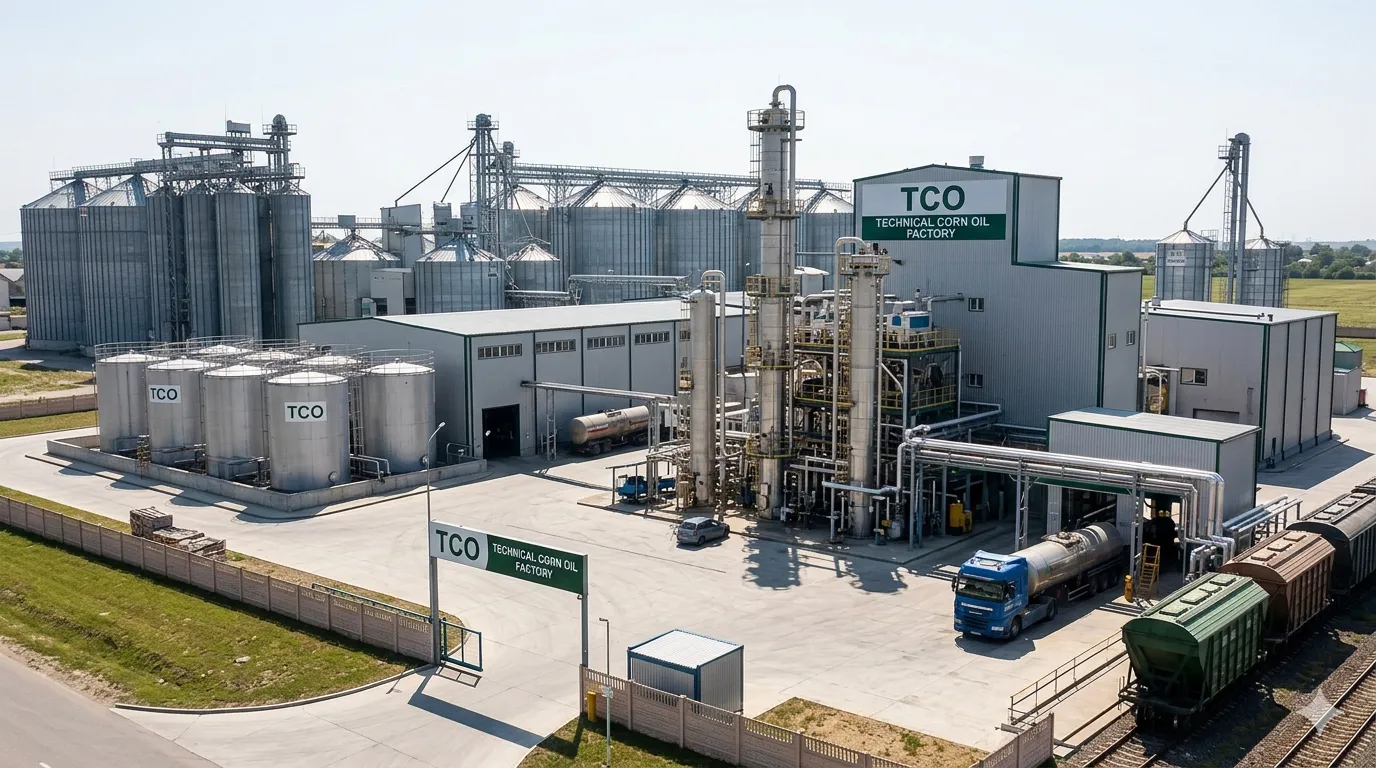
Corn Technical Oil (TCOE) is a viscous reddish-yellow liquid obtained during the industrial dry milling of corn for bioethanol production. Its high unsaturated fatty acid content — especially linoleic (51–57%) and oleic (28–33%) — makes it a critical raw material for the advanced biofuels industry.
Unlike edible corn oil, TCOE is not refined for human consumption: it is sold crude to industrial clients who process it into renewable biodiesel, HVO, oleochemicals or energy supplements for animal nutrition.
1. Ethanol conversion. Corn is milled and its starches are enzymatically hydrolyzed to fermentable sugars. Yeasts then convert the sugars into ethanol during fermentation.
2. Centrifugation. After ethanol distillation, the remaining mash is centrifuged into two phases: wet distillers grains (WDG, later dried into DDGS) and thin stillage.
3. Oil extraction. A second phase separation over the thin stillage concentrates the fat content, producing Corn Technical Oil ready for bulk shipment.
Raw material for conventional biodiesel (FAME) and renewable diesel (HVO/HEFA). High unsaturated fatty acid content and low phosphorus make it ideal for catalytic hydrogenation processes.
Input certifiable under RED III / EPA RFS2 schemes for sustainable aviation fuels and second-generation renewable diesel.
Energy concentrate for feedlot cattle, swine and poultry rations. Improves caloric density and palatability of the diet.
Base for surfactants, biodegradable lubricants, technical waxes and materials for the paints and coatings industry.
Typical values based on recent batches. Shipment-specific analytical values are provided with dispatch documentation.
| Parameter | Value | Method |
|---|---|---|
| Moisture and volatile matter | < 0,8% p/p | ISO 662:1998 |
| Acidity (g oleic acid/100g) | < 15% | ISO 660:2009 |
| Sediments | < 2,5% p/v | ISO 15301:2001 |
| Density at 25 °C | < 0,920 g/cm³ | ASTM D4052:2021 |
| Sulfur | < 80 mg/kg | ASTM D5453 |
| Phosphorus | < 150 mg/kg | ASTM D4951 |
| Refractive index (25 °C) | 1,471 | IRAM 5505 |
| Iodine value | 120 – 126 | AOCS Cd 1c-85 |
| Saponification value | 184 – 196 mg KOH/g | AOAC 920.160 |
| Palmitic acid (C16:0) | 10 – 11% p/p | IOCR02 |
| Stearic acid (C18:0) | 1,6 – 2% p/p | IOCR02 |
| Oleic acid (C18:1) | 28 – 33% p/p | IOCR02 |
| Linoleic acid (C18:2) | 51 – 57% p/p | IOCR02 |
| Linolenic acid (C18:3) | 1 – 1,4% p/p | IOCR02 |
| Aflatoxin | < 1 μg/kg | AOAC 2013.05:2023 |
Tell us what you need (technical sheet, physical sample, formal quote) and our sales team gets back to you within 24 business hours.
High-yield, cost-efficient vegetable protein source. By-product of the corn ethanol industry.
Soybean and sunflower oils for industrial, energy or nutritional use, with logistics optimised from origin.
We act as a solutions integrator bridging primary production and the technical needs of global markets. Tell us the product, volume and destination — we'll come back with a tailored proposal.